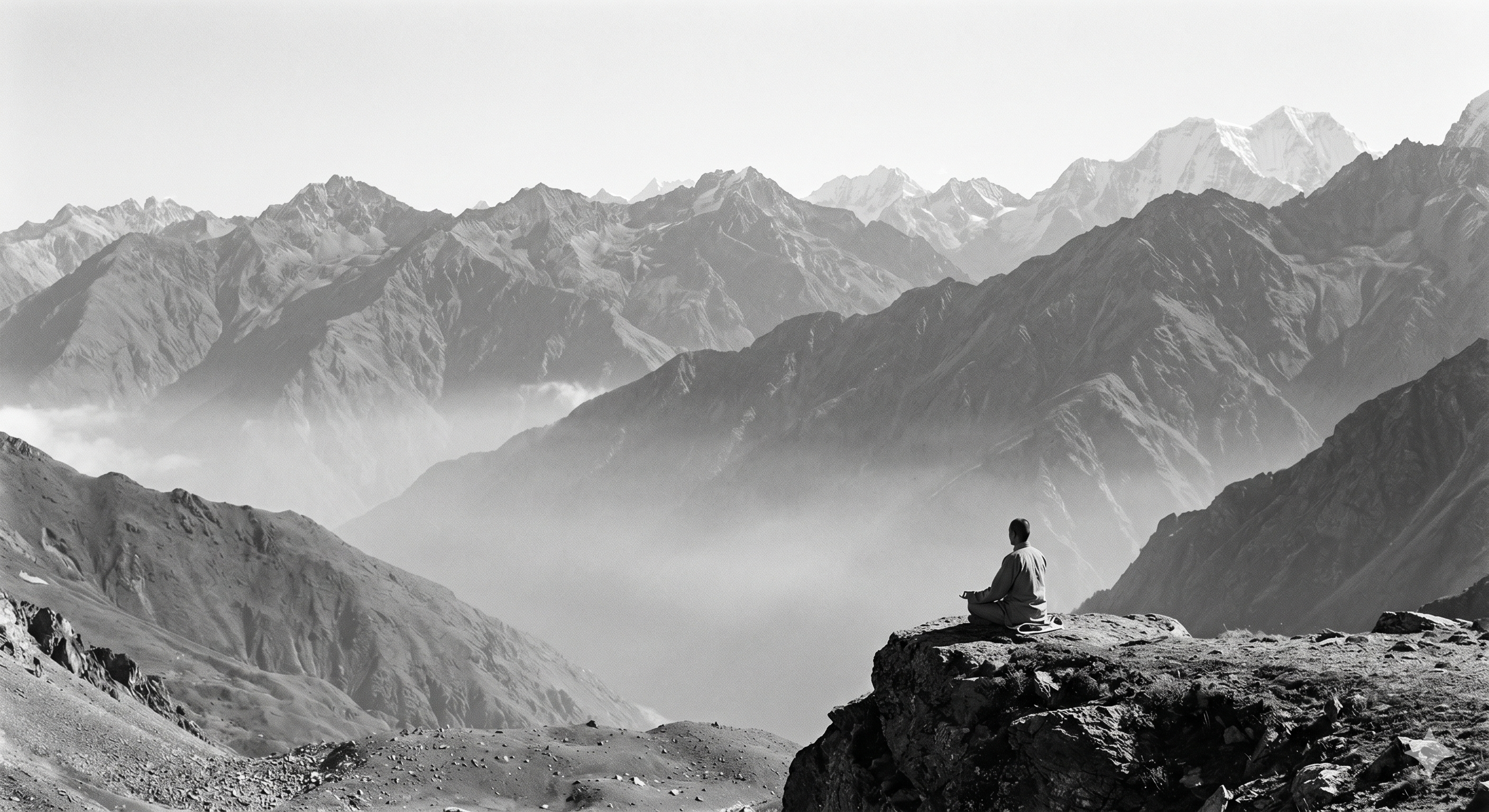
On Vairagya
Renunciation is not detaching from things. It is detaching from the categories that name them.
One hears the word and immediately assumes a person who has shaved his head, left society, and gone to live in the mountains. Only through renunciation can liberation be achieved — that is what the third person assumes, especially when in trouble. If I leave all this which is causing me affliction, I will be free. It is a thought reached for in turmoil; rarely is it investigated.
But the problem rarely lives in the location. Without inquiry into how the problem arose in the first place, the same problem will find the seeker on the mountain as surely as it did in the city.
The Subtler Attachment
When the books speak of detachment, they speak almost entirely about detachment from the things one likes. They rarely speak about detachment from the things one dislikes — because no one consciously believes they are attached to suffering. No one volunteers for pain.
And yet, on closer inspection, people are attached to the bad. They are attached unconsciously. They seek out trouble, often without admitting it, so that the days called good are kept lit by the contrast of the days called bad. The misfortune is held onto because without it, the good has no shape. This is the subtler attachment, and it is the one the books almost never name.
The reader, missing all of this, takes the instruction to mean give up everything I like — and runs off to a place where, sure enough, the pleasures and attachments follow, with new pain added from unfamiliar conditions.
What Is Actually Being Asked
To understand vairagya, one must first see what is actually being asked to be let go of. The instruction is not to drop the objects. It is to drop the categories — the attachment to good, the aversion to bad, and the underlying assumption of I, me, mine that holds both categories in place.
So the question to investigate is: who tags things as good or bad? Where do these categories arise? Do they exist out in the world — in the food, the person, the situation — or are they conceived in the mind that meets them?
The Nature of It
The one steady in this inquiry sees that the universe is as it is. There is no good or bad in it. It is the mental reality of the observer that gives meaning, separates, and divides. The moment one thinks “this is a universe,” the universe begins.
For such a person, vairagya is not refusing the nice food. It is the absence of any relationship to the ideas of good and bad, attachment and aversion, I, me, and mine. When awareness is complete, such thoughts seldom arise — the body and the universe are seen as they are.
This is vairagya.
It is not a state to be achieved. It is the nature of the Self.